Last post, I shared some information about what SPD is. This time I want to talk about what it is NOT. I am a big advocate for understanding sensory processing and helping families navigate the difficulties that come with the various sub-types, affecting a child’s development and participation in daily life. As part of that advocacy, I often find myself responding to mistaken ideas that people have about SPD.
While October is SPD Awareness Month, it seems that in some circles SPD is a trending topic year-round. And there is misinformation that comes with that sort of fame. So, just to set the record straight and improve our understanding of sensory processing disorder, here are a few points of clarification:
Sensory Processing Disorder (SPD) is NOT a medical diagnosis.
The STAR Institute worked for more than a decade to have SPD added to the Diagnostic and Statistical Manual – 5th Edition (DSM-5). These listings include clear diagnostic criteria and guide a physician in making medical diagnoses for mental and neurological disorders. When the DSM-5 was published in 2015, the editing board ultimately determined that there was not enough evidence to support the addition of SPD as a separate diagnostic category. They did, however, add sensory processing issues (sensory hyper- or hypo-sensitivity) as an additional criteria of Autism Spectrum Disorders. The STAR Institute continues to support research in this area to help identify SPD as a unique diagnosis.
SPD is not what everyone with “quirks” has.
We all have sensory differences, and some of us have specific preferences or needs when it comes to sensory input. If you don’t like scratchy sweaters or need to have silence to get work done, you don’t have SPD. Individuals with SPD experience the world very differently and struggle to participate fully in it due to their difficulty interpreting and responding to sensory input. The hallmark of SPD, as described by Dr. Lucy Miller (STAR Institute founder), is that the condition is chronic and disruptive to daily life.
SPD is not something that can be “fixed” or “cured” by treatment.
BUT, the symptoms can often be reduced in intensity, with a resulting decrease in the impact of SPD on a person’s daily life. A comprehensive therapy approach includes direct treatment to help with learning skills and potentially altering how sensory information is received and processed. It would also include education regarding how to manage daily tasks and accommodate the individual’s unique sensory needs. Skilled therapists help individuals to advocate for themselves and better understand how to cope with SPD, while educating families (and others) to facilitate an understanding of the condition that changes relationships and supports participation in daily life.
Sensory-sensory based treatment is not the answer to every problem.
Issues with learning, behavior, social interactions, or daily task participation may not all be solved with therapy. There is a growing trend toward using sensory based strategies to support all children who exhibit difficulty with self-regulation, attention, learning, behaviors, and social interaction, but using a “sensory lens” to address these issues may be only one piece of a complex puzzle that needs to be solved in order to best support a child’s development and success in daily life. Understanding SPD can be helpful in solving problems for children who exhibit symptoms of the disorder, but it is most powerful when you combine it with a full understanding of the child and the specific challenges they experience.
Our blog series for SPD Awareness Month continues soon, with more information on the sub-types and resources to help children with them.
And don’t forget: if you’re local, join us at our Introduction to SPD with Q&A events on October 26 and 30. Learn more here, and contact us for more information about SPD or to discuss your child’s needs.
The post Here’s What Sensory Processing Disorder is NOT appeared first on Right Steps for Kids.
]]>Understanding sensory processing disorder can be difficult in large part due to the fact that there is not currently a medical diagnostic description for it. Other disorders like autism, ADD, or specific learning disorders have this kind of outline, and are known well to health professionals and parents alike.
While Jean Ayres, PhD, OTR defined sensory integration and sensory integration dysfunction in the 1970’s, there has been on-going research and diverging theories that actually make it even harder for us to talk about SPD as a condition. One could argue semantics over a philosophical debate, but when discussing a medical condition, it’s most helpful to have a common language. It ensures we’re all on the same page.
To that end, Dr. Lucy Miller has proposed using the term “Sensory Processing Disorder” as an umbrella term that includes six sub-types of the disorder. The below graphic is a little dense, but it gives you an idea of the umbrella and everything that’s underneath it.
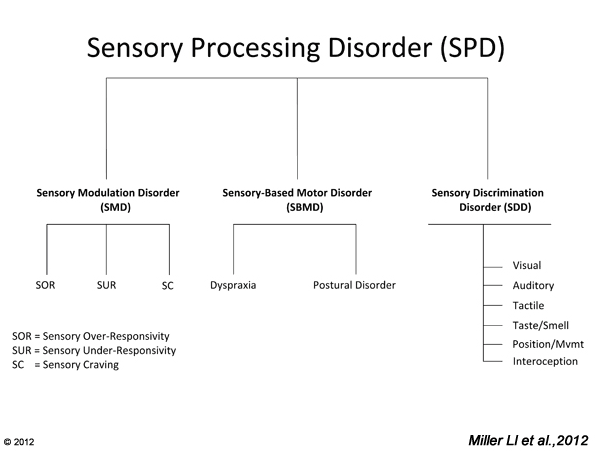
In upcoming blog posts, I’ll explore each sub-type more in depth. But to start, here are some key points that are helpful in understanding SPD:
- SPD is not one condition but rather a collection of conditions that are each unique in terms of symptoms.
- SPD includes disorders of the 8 sensory systems:
- Visual
- Auditory
- Tactile (touch)
- Gustatory (taste)
- Olfactory (smell)
- Vestibular (movement)
- Proprioception (body awareness, position)
- Interoception (internal organs)
- Dyspraxia and Postural Disorder – motor-based disorders – are most closely associated with problems in processing vestibular (movement) and proprioceptive (body awareness) input.
- Modulation disorders (when it’s hard for someone to regulate their level of alertness) can affect any of the 8 sensory systems and often appear in combination.
- For example, a person might be SOR (sensory over-responsive) in auditory, SUR (sensory under-responsive) in tactile, and sensory craving in vestibular/movement.
- Sensory discrimination disorders are the inability to perceive subtle differences in sensory information. That leads to poor interpretation or perception of information, and these disorders can affect any of the 8 systems.
- An individual can have any of the 8 systems affected by sensory processing issues. This creates a huge list of potential combinations of SPD sub-types – millions of possible combinations when you do the math!
- In order to determine what approach, strategies, and accommodations will help with reducing the impact of the disorder, in-depth examination and understanding of an individual is essential.
Hopefully, that’s a good start on the basics of SPD, and what’s meant by sub-types and various disorders with in the condition. Next up: We’ll look at each sub-type individually and explore the various associated behaviors you might encounter in children struggling with them.
And don’t forget: if you’re local, join us at our Introduction to SPD with Q&A events on October 26 and 30. Learn more here, and contact us for more information about SPD or to discuss your child’s needs.
The post The Six Sub-Types of Sensory Processing Disorder appeared first on Right Steps for Kids.
]]>In addition to our in-clinic treatment, it’s a goal at STEPS For Kids to bring you factual, helpful information on the conditions, issues and discussions that matter to you. As part of our education and advocacy efforts, this month we’re excited to bring you information about sensory processing and SPD (sensory processing disorder).
All month, I’ll share my thoughts and some educational information here. Plus, we’re hosting an Introduction to SPD presentation at the clinic later in October. I hope you find the information helpful and enlightening, whether you have been dealing with sensory processing disorder for a long time or have just discovered SPD and its impact on behavior and learning.
According to the STAR Institute, many people think that SPD is something that only children with autism have. While it is true that many individuals on the autism spectrum also display signs of SPD, recent research indicates that SPD is in fact a unique condition. Most individuals who have SPD actually do not have autism.
Research also shows that while some individuals have SPD and other conditions such as attention disorders, learning disorders, and developmental delays, there are some individuals who only have SPD.
There will be much more information to come as the month goes on, but to get started, here are some things to know about SPD:
- It is a condition that was first described by Jean Ayres, PhD, OTR in the 1970’s, following her research working with children who had cerebral palsy and learning disorders. She created a body of work that described sensory integration as the neurological process and referred to sensory integration dysfunction.
- Sensory integration assessment and treatment are based on neurological principals of how the brain receives and organizes sensory information so as to produce an adaptive response that lets us be successful in a task.
- Sensory Processing Disorder is an umbrella term for the disorder and includes six sub-types, as described by Lucy Miller, PhD, OTR of the STAR Institute.
- The six sub-types include:

- Modulation Disorders (Over-responsive; Under-responsive; Craving)
- Sensory Based Motor Disorders (Dyspraxia; Postural Disorder)
- and Sensory Discrimination Disorders
- There are 8 sensory systems that can be affected:Visual
- Auditory
- Olfactory (smell)
- Gustatory (taste)
- Tactile (touch)
- Vestibular (movement)
- Proprioceptive (body awareness)
- Interoception (internal organs/systems)
- A person can have multiple sub-types, impacting one or more sensory systems. For example: being over-responsive to auditory stimulation, under-responsive to touch, and have a postural disorder.
- Sensory processing occurs on a continuum. We all have sensory differences and none of us has all 8 sensory systems operating at 100% all the time. The hallmark of SPD is when the impact of symptoms is chronic and disruptive in daily life.
- Research indicates that between 5 and 16% of children have SPD symptoms that are significant enough to negatively daily life activities, including play, social skills, learning, and self-care.
- Negative behavior associated with SPD can disrupt relationships and impact a child’s self-esteem significantly. A child who doesn’t respond to the world appropriately is perceived as “bad” and receives negative responses from others, which in turn creates more problem behavioral responses and “keeps the child in misery” as described by Dr. Ayres.
- Occupational therapists who have advanced training in SPD can help to remediate symptoms and improve daily task participation, address social and play skills, and support relationships for lifelong success.
There is so much to know about the current state of SPD assessment, treatment, and accommodations. Learning more about the disorder, separating fact from myth, and understanding each other through a “sensory lens” is one way that we can support others to be competent and confident in daily activities. I hope you’ll stay with us all through October to learn more!
And don’t forget: if you’re local, join us at our Introduction to SPD with Q&A events on October 26 and 30. Learn more here, and contact us for more information about SPD or to discuss your child’s needs today.
The post October is Sensory Processing Awareness Month appeared first on Right Steps for Kids.
]]>